
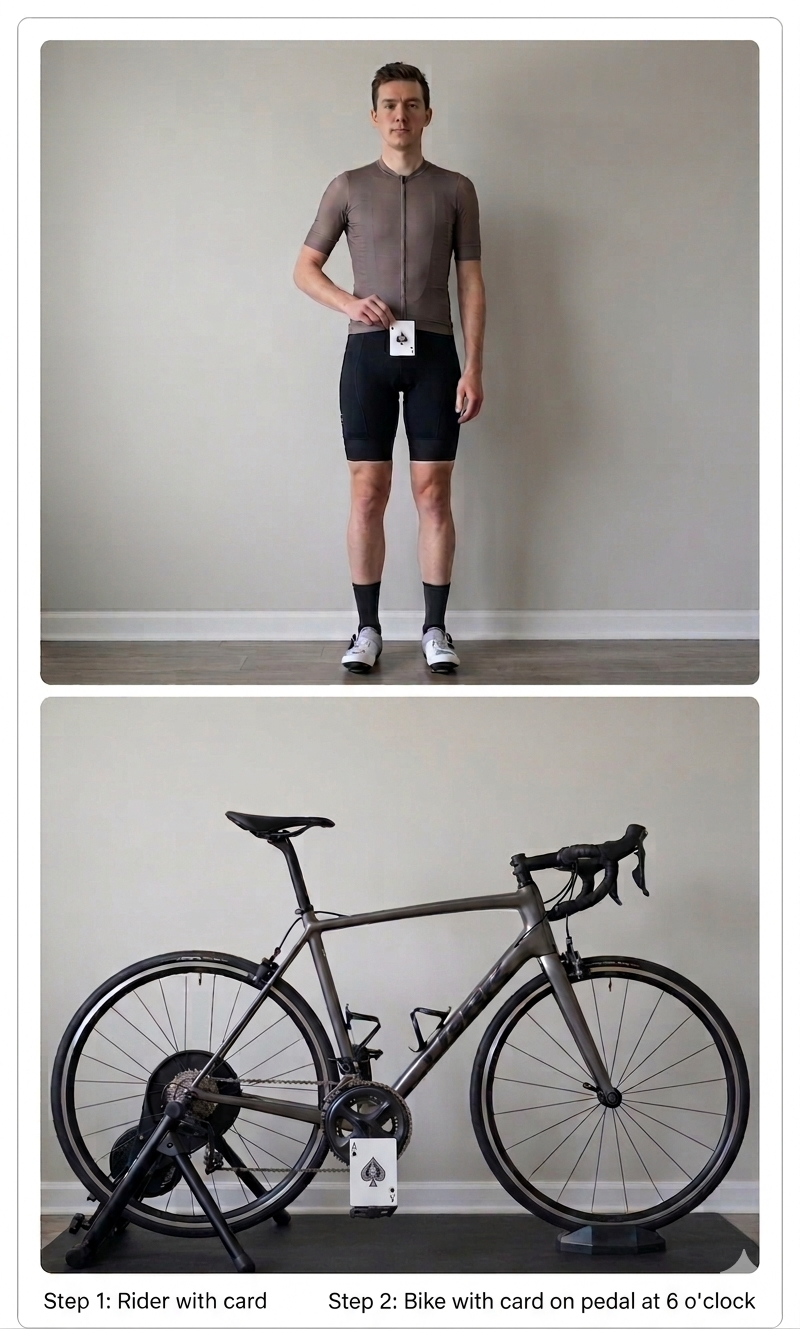
How the Saddle Height Calculator Works
- 01Stand in your cycling shoes and hold a standard playing card (88.9mm × 63.5mm) to your side with the face pointing toward the camera. Have someone photograph your full body from head to toe from about 6 feet away.
- 02Place your bike on a trainer with the crank arm pointing straight down — 6 o'clock position. Rest the playing card on the pedal face-out toward the camera. Photograph the full bike from the side at about 8 feet away.
- 03Upload both photos. The AI locates the card in each image and computes the exact pixel-to-millimeter ratio from its known dimensions, then measures your inseam (floor to crotch) and current saddle height (bottom bracket center to saddle top).
- 04Your result shows your current saddle height, your ideal saddle height calculated using the LeMond method (inseam × 0.883), and a precise adjustment in millimeters — raise or lower.
Why Saddle Height Matters for Performance and Injury Prevention
Saddle height is the single most impactful bike fit variable. A saddle set just 5mm too high forces your hip to rock on each downstroke as your leg reaches for the pedal. Over time this causes IT band irritation along the outer knee, lower back pain, and hotspots at the back of the knee.
A saddle set too low over-flexes the knee, increasing compressive force on the patella and causing anterior knee pain — burning at the front of the knee — and reduces the power you can transmit through each pedal stroke.
Research shows that optimal saddle height reduces oxygen consumption (VO₂) by up to 5% compared to a poorly fitted position, meaning a correct saddle height makes you both more comfortable and faster (Nordeen-Snyder, 1977).
Saddle height is defined as the vertical distance from the center of the bottom bracket axle to the top of the saddle, measured along the seat tube centerline.
Saddle Height Formulas Explained (LeMond, Holmes, Hamley)
LeMond Method — inseam × 0.883
Developed by three-time Tour de France winner Greg LeMond, this formula multiplies your inseam length in millimeters by 0.883. A cyclist with an 800mm inseam targets approximately 706mm of saddle height. This is the most widely used starting point for road and gravel cyclists, and the formula AxyZ uses.
Holmes Method — 25–35° knee flexion at BDC
The Holmes method sets saddle height so the knee has a 25–35 degree bend at bottom dead center (6 o'clock pedal position). This angle-based approach accounts for individual anatomical variation — particularly differences in femur length relative to inseam — and is preferred by physiotherapists and sports medicine practitioners. AxyZ's full video analysis measures this angle directly from your pedaling footage.
Hamley and Thomas Method — inseam × 1.09
One of the earliest peer-reviewed saddle height studies — Hamley EJ and Thomas V (1967), J Physiol — determined that optimal saddle height equals inseam multiplied by 1.09, measured from the pedal axle at the bottom of the stroke to the top of the saddle. Because it measures from the pedal rather than the bottom bracket, this produces a higher number than the LeMond formula while targeting the same anatomical position.
Signs Your Saddle Height Is Wrong
Saddle too high
- Hips rocking side-to-side during pedaling
- IT band pain along the outer knee
- Hotspots or numbness at the back of the knee
- Feeling like you're reaching for the pedal
Saddle too low
- Burning at the front of the knee (patella)
- Quads fatiguing earlier than expected
- Feeling cramped through the pedal stroke
- Hip angle compressed at the top of the stroke
Note: changing cycling shoes, cleats, or pedal systems changes your effective saddle height. The combined stack height of shoe, cleat, and pedal raises or lowers your foot position relative to the bottom bracket. Re-run this calculator any time you change footwear or pedal systems.
Saddle Height Chart by Rider Height
LeMond target (inseam × 0.883) estimated from average inseam for each height. Inseam varies significantly between individuals — use the calculator above for a measurement specific to you.
| Rider Height | Typical Inseam | LeMond Target |
|---|---|---|
| 155 cm (5′ 1″) | 72 cm | 636 mm |
| 160 cm (5′ 3″) | 74 cm | 653 mm |
| 165 cm (5′ 5″) | 77 cm | 680 mm |
| 170 cm (5′ 7″) | 79 cm | 697 mm |
| 175 cm (5′ 9″) | 82 cm | 724 mm |
| 180 cm (5′ 11″) | 84 cm | 742 mm |
| 185 cm (6′ 1″) | 87 cm | 768 mm |
| 190 cm (6′ 3″) | 90 cm | 795 mm |
| 195 cm (6′ 5″) | 93 cm | 821 mm |
Frequently Asked Questions About Saddle Height
What is the correct saddle height for cycling?
The ideal saddle height is calculated as inseam (mm) × 0.883 using the LeMond method. This targets a knee bend of 25–35 degrees at the bottom of the pedal stroke. Saddle height is measured from the center of the bottom bracket to the top of the saddle along the seat tube.
How do I measure my inseam for bike fitting?
Stand in your cycling shoes with feet about 15cm apart. Press a book firmly between your legs at crotch height, as a saddle would. Measure from the floor to the top of the book. AxyZ measures this automatically from your standing photo using a playing card as a scale reference.
What is the LeMond saddle height formula?
Inseam (mm) × 0.883. Developed by three-time Tour de France winner Greg LeMond, it is the most widely used starting point for road and gravel bike fitting. A cyclist with an 800mm inseam targets approximately 706mm of saddle height.
What happens if my saddle is too high?
Your hips rock side-to-side on each downstroke. Over time this causes IT band irritation (outer knee pain), lower back pain, and hotspots at the back of the knee. A saddle just 3–5mm too high can trigger IT band syndrome.
What happens if my saddle is too low?
The knee is over-flexed on each stroke, increasing compressive force on the patella. This causes anterior knee pain — burning at the front of the knee — and reduces pedaling efficiency. Cyclists feel cramped and lose power through the bottom of the stroke.
How does the playing card scale reference work?
Standard playing cards measure exactly 88.9mm × 63.5mm. When the card appears in a photo, the AI computes the exact pixel-to-millimeter ratio from its known dimensions. This makes a playing card a precise, accessible calibration tool that anyone already has at home.
How accurate is a photo-based saddle height measurement?
Under good lighting with the card fully visible, accuracy is within 5–10mm — enough to identify whether a meaningful adjustment is needed. For precision within 2–3mm, or for lateral fit (cleat alignment, knee tracking), a professional fitter with motion capture is recommended.
Sources
- Hamley EJ, Thomas V. Physiological and postural factors in the calibration of the bicycle ergometer. J Physiol. 1967;191(2 Suppl):55P–56P.
- Nordeen-Snyder NS. The effect of bicycle seat height variation upon oxygen consumption and lower limb kinematics. Med Sci Sports. 1977;9(2):113–117.
AxyZ saddle height calculator · Last updated · Powered by Claude AI Vision